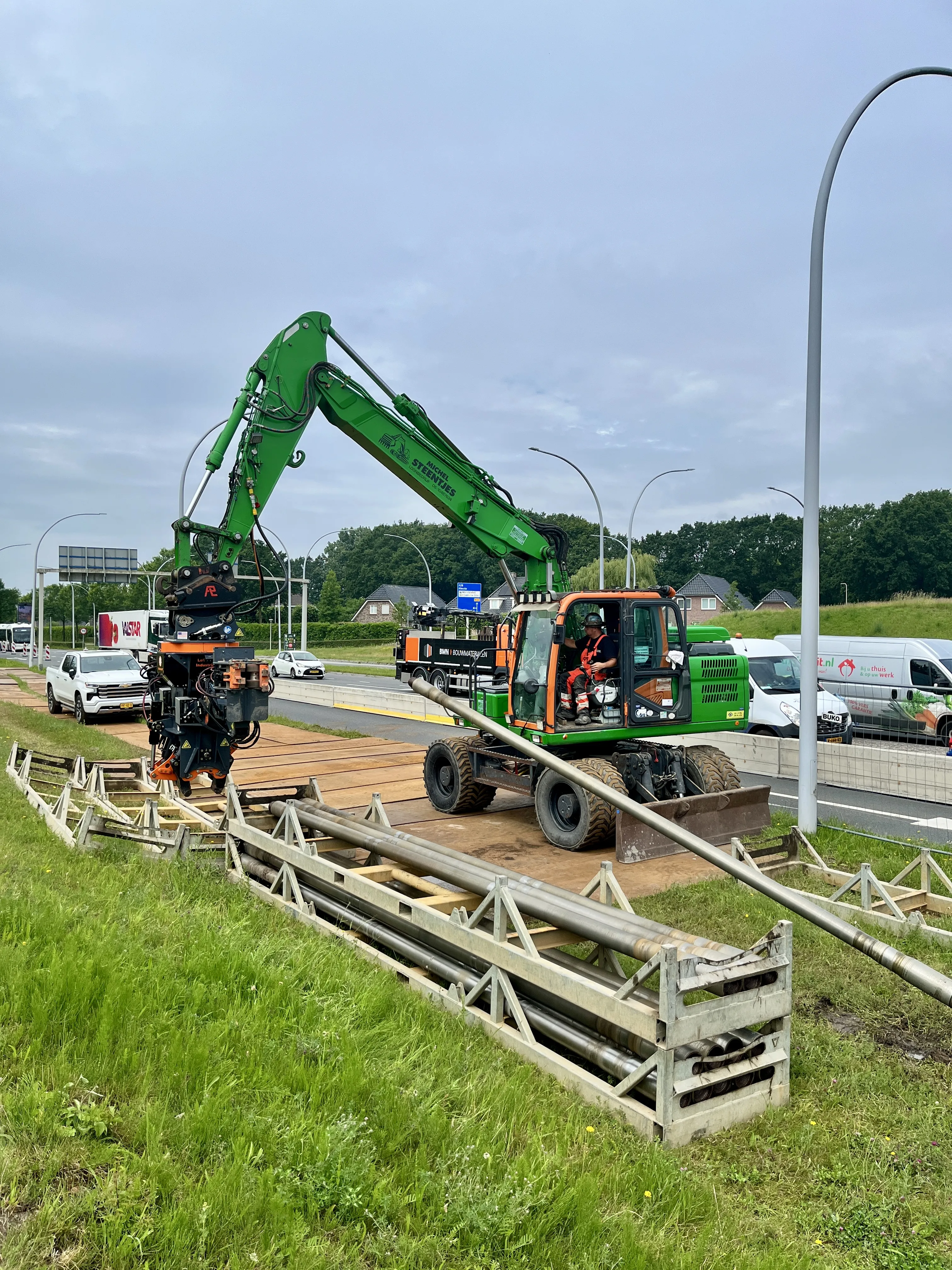
Welvreugd first worked with the Tonghand on a project with its 180-tonne rig in Rilland, Zeeland. The tool was hired to find out whether forward reaming would deliver enough practical benefits on the jobsite. The answer was yes. In Zwolle, we catch up with the crew again. Here too, a rented Tonghand is hanging from the crane. This time, not as a test, but as confirmation of a way of working the Dutch drilling company wants to use more often where the job allows.
Faster rod handling at the exit side
On the outskirts of Zwolle, Welvreugd is working on a series of HDD crossings for new high-voltage cables running towards an industrial estate. The first bore is 250 metres long. Today marks the first reaming pass. A second pass follows tomorrow, and after the weekend the pipe will be pulled in. Seven more bores will follow, all with the same reaming diameter.
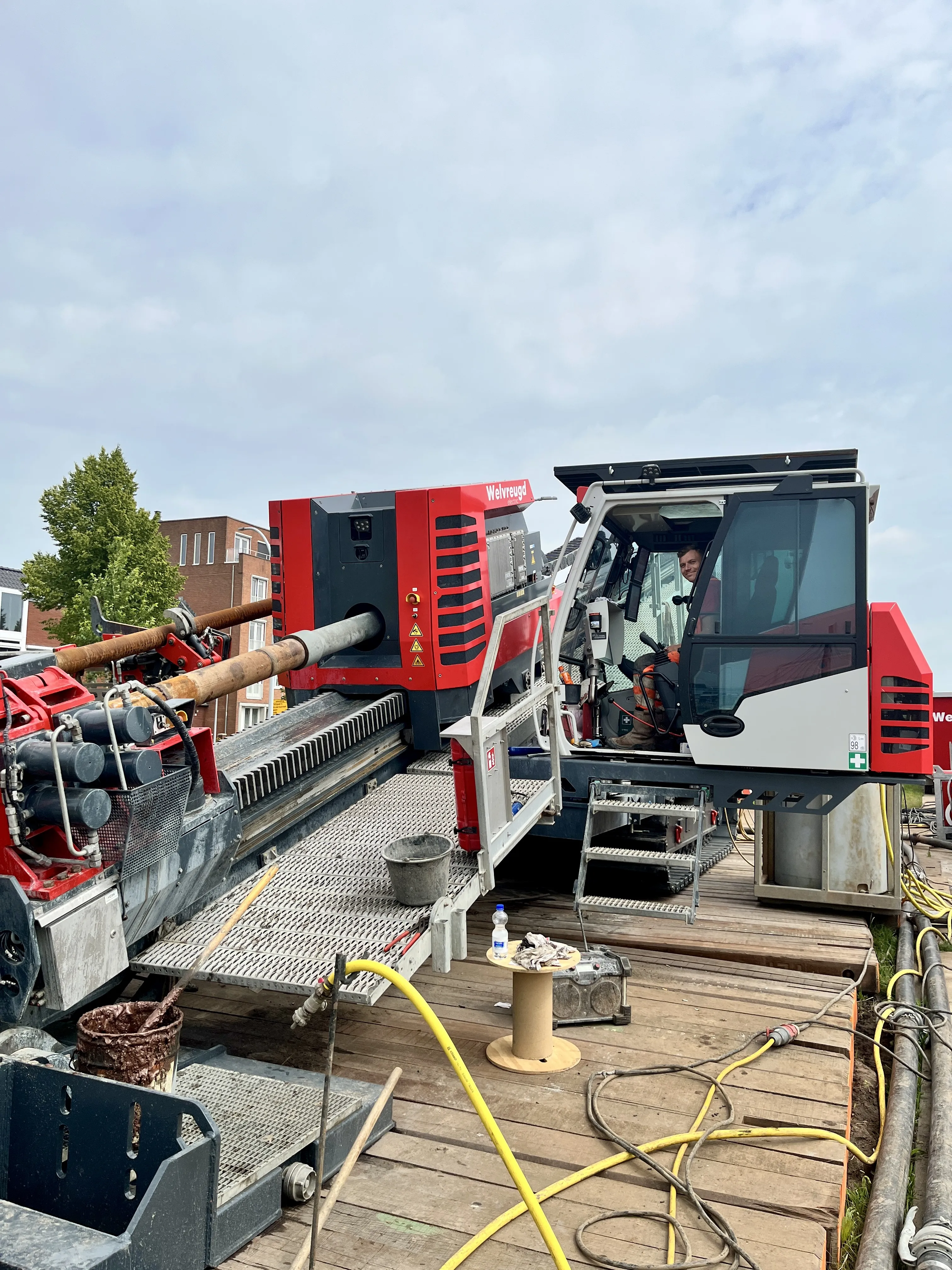
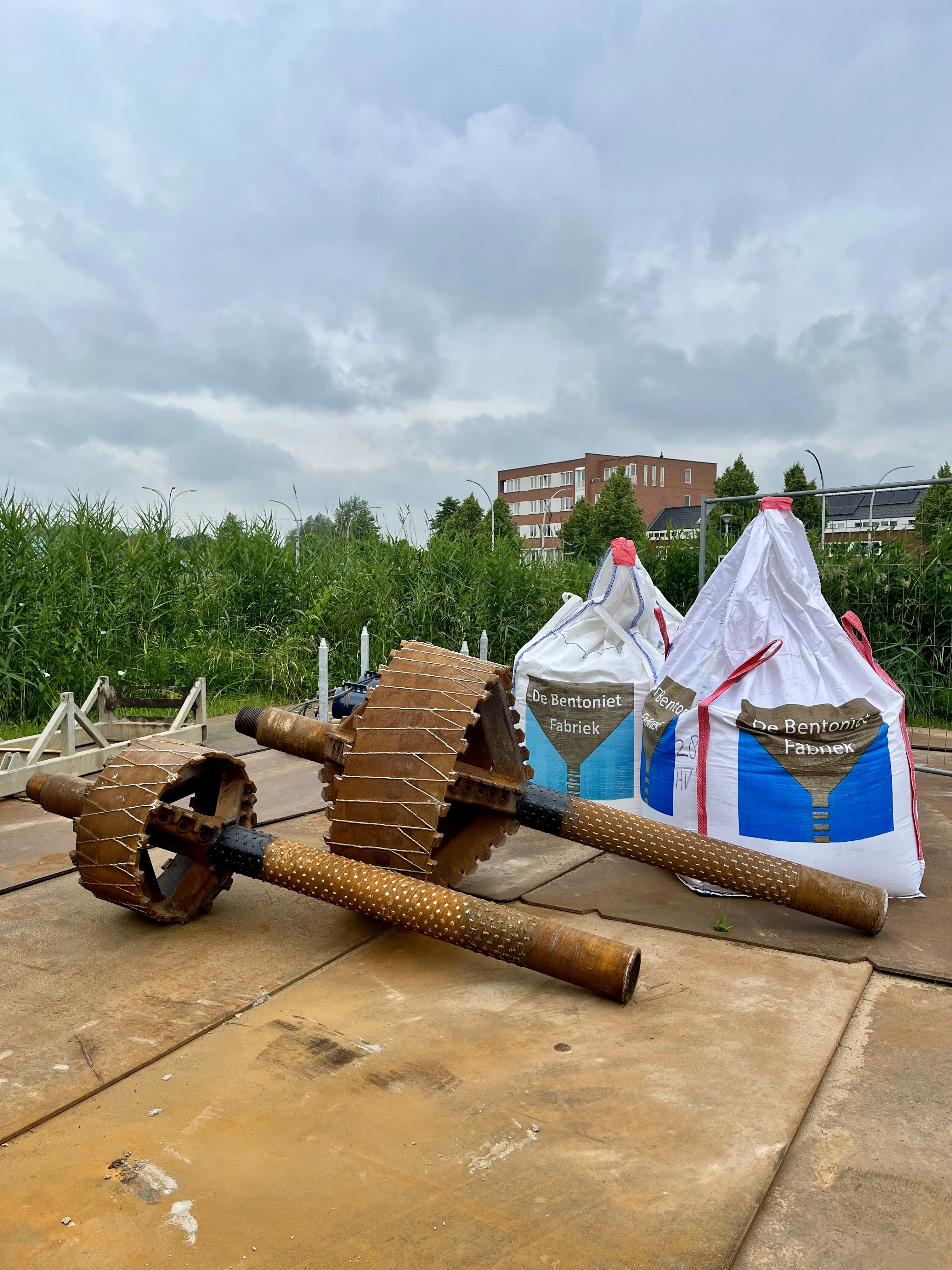
At the exit side, Michel Steentjes is ready in his crane. The clamp he had worked with for the past five years has made way for a Tonghand, a change that has significantly altered the workflow for the experienced operator. “These days, I’m already done here before they’re ready at the rig side,” Michel says. “The rod comes up, I break it out, and then I’m waiting for the pump. It makes barrelling a lot more enjoyable. We’re reaming to 910 here, so this is serious work. And there’s a lot of sand and soil coming up with it.”
Out of the danger zone
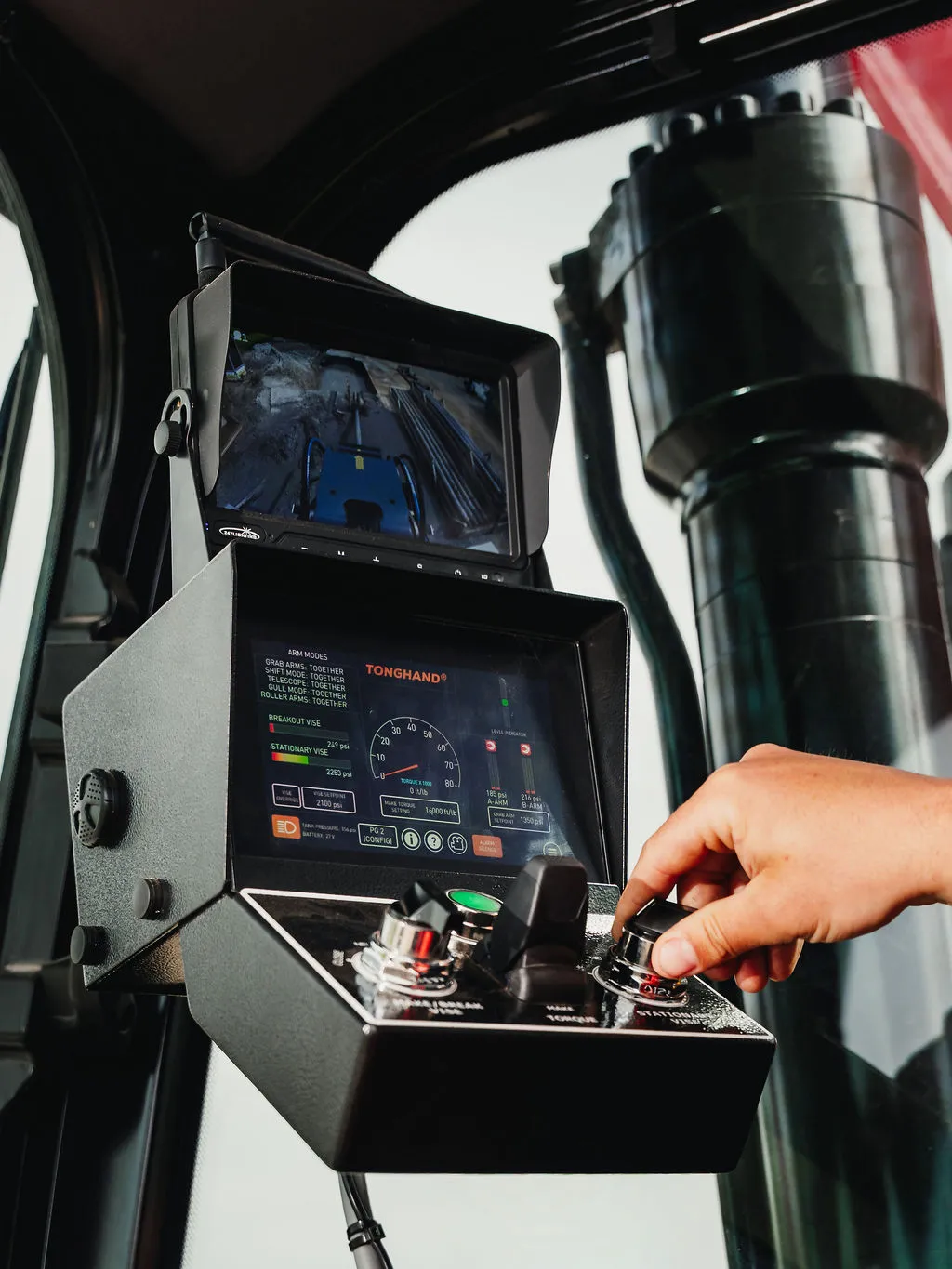
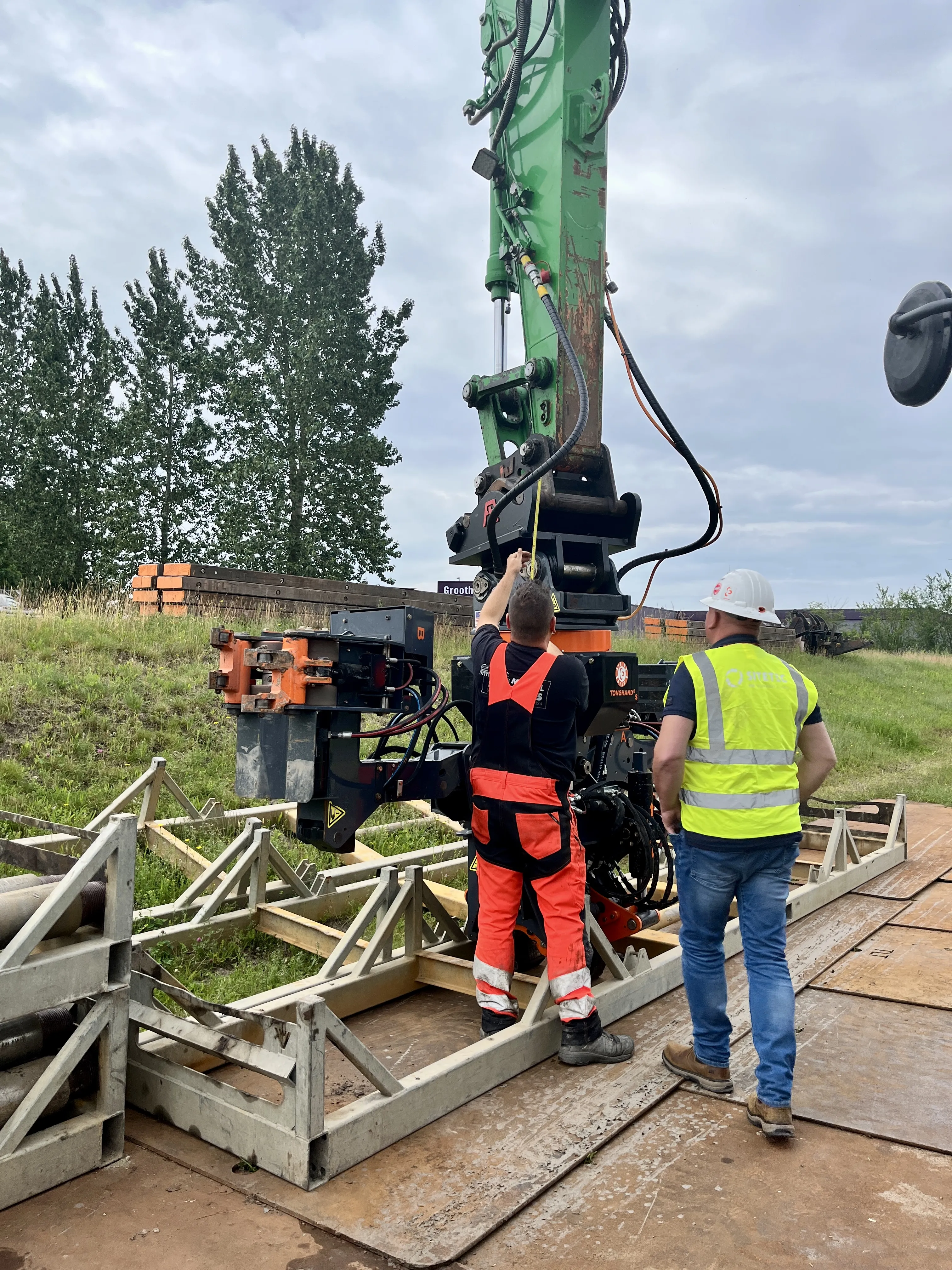
Does Michel also find the new unit safer? “Welvreugd’s own clamp had already made my job a lot safer because we no longer needed a lifting sling, but with the Tonghand, safety is obviously next level. I can stay in the cab and nobody needs to stand next to it.”
His experience with that in-house clamp comes in handy when learning to work with the Tonghand. “You do have to get the hang of it,” the operator says in his down-to-earth way. “But once you do, it’s a great bit of kit. For me, it’s also a welcome challenge. I have my own crane and it’s now fully set up for the Tonghand. I wanted two custom joysticks fitted as well. The next step is an electric crane. Then we’ll really have the full package, of course.”His walkie-talkie crackles. “Here comes another one. I’m getting back in the cab.”
When forward reaming pays off
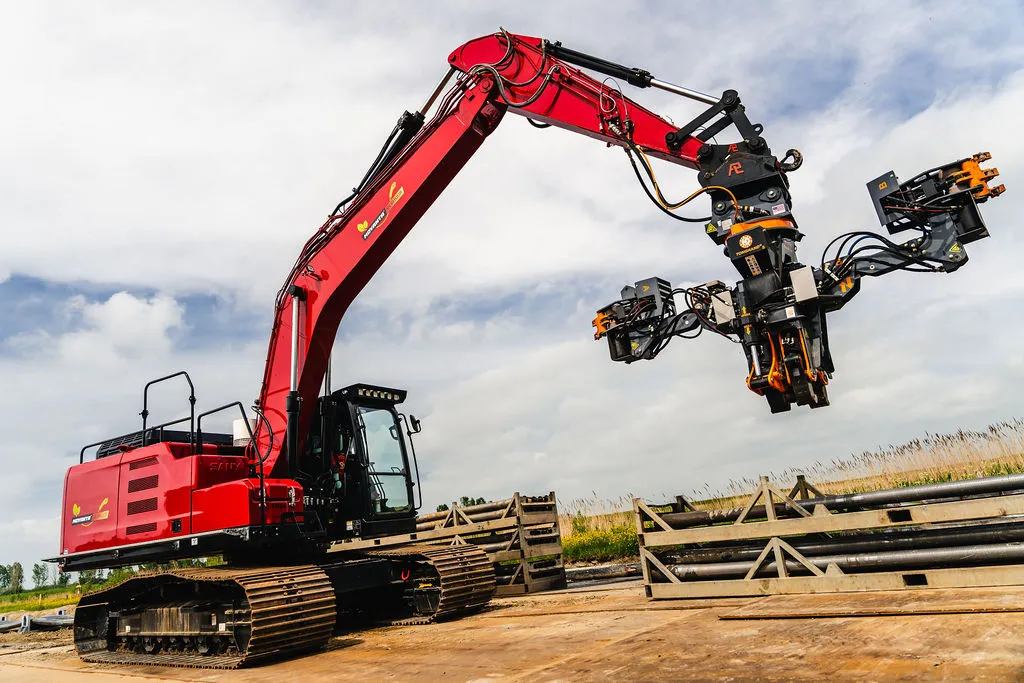
At the rig side, we meet supervisor and co-owner Piet. The jobsite sits right next to a nursery, in a residential area with high-voltage cables in the background. Welvreugd is drilling here to create a connection between the high-voltage network and the industrial estate on the other side of the motorway. “Our project in Rilland, Zeeland, was what prompted us to look into using a Tonghand. We needed to work as efficiently as possible there, and forward reaming gave us that opportunity. So we decided to rent one first and see what it would actually deliver in practice. I can tell you, we saved quite a bit.”
Forward reaming is not an option everywhere. In the Netherlands, the ground is often soft, which can make it difficult to keep the reamer properly centred. So why does Piet still believe investing in a Tonghand makes sense in a country where sandy ground is so common?
“Of course, you need to be able to keep the reamer under control,” Piet explains. “If you can’t, it simply doesn’t work. But when conditions are right, it can make a huge difference, as Rilland already showed. Here in Zwolle, there’s another reason as well: the client had a specific request, and the Tonghand helps us meet it.”
Fewer vacuum trucks on a sensitive jobsite
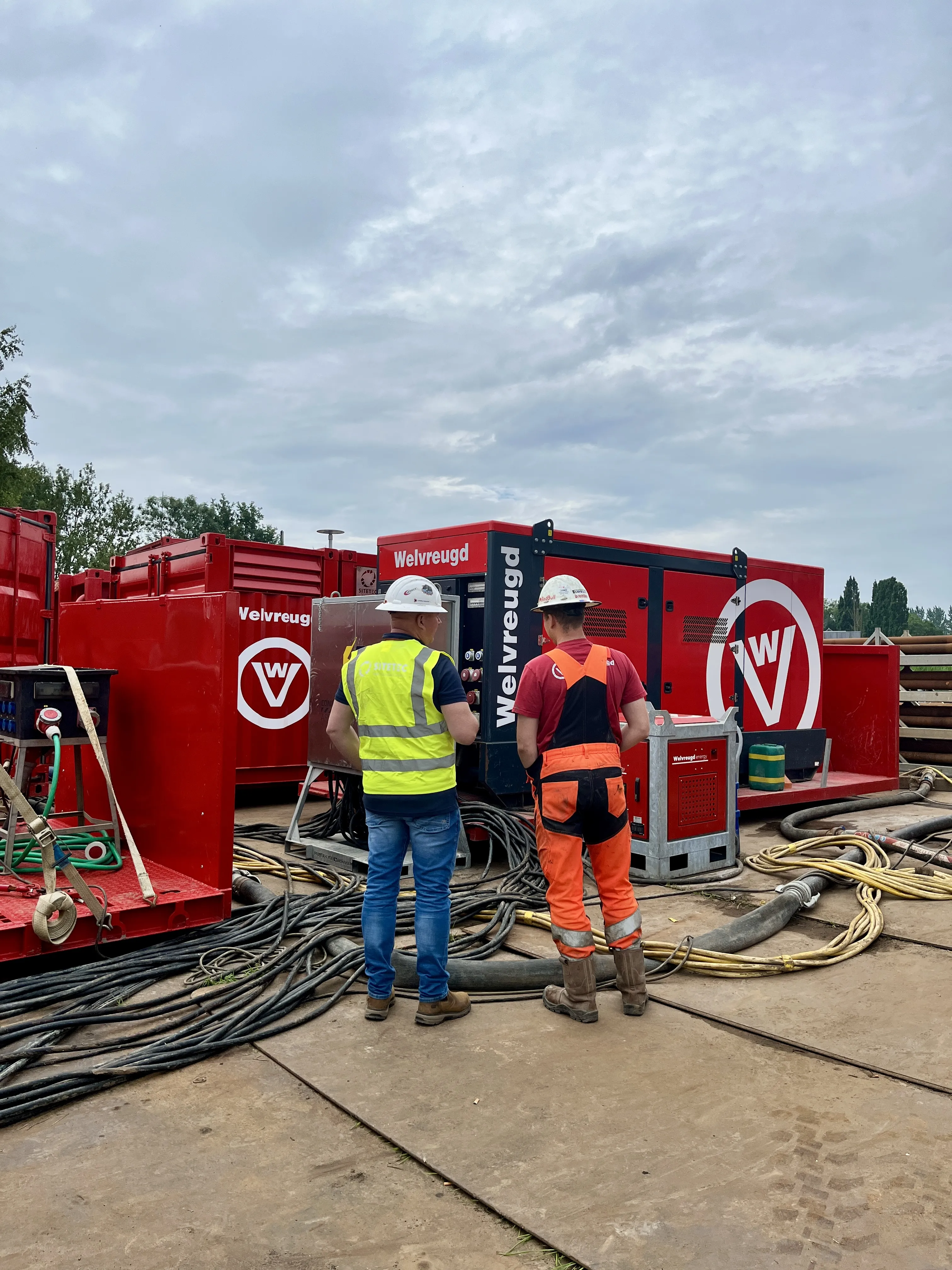
Welvreugd had already won the contract from the municipality. The job would be carried out fully electrically to minimise noise disturbance for the surrounding area. A quiet setup, well suited to the location. But during preparations, another issue came up: the number of vacuum trucks travelling back and forth would create considerable disruption.
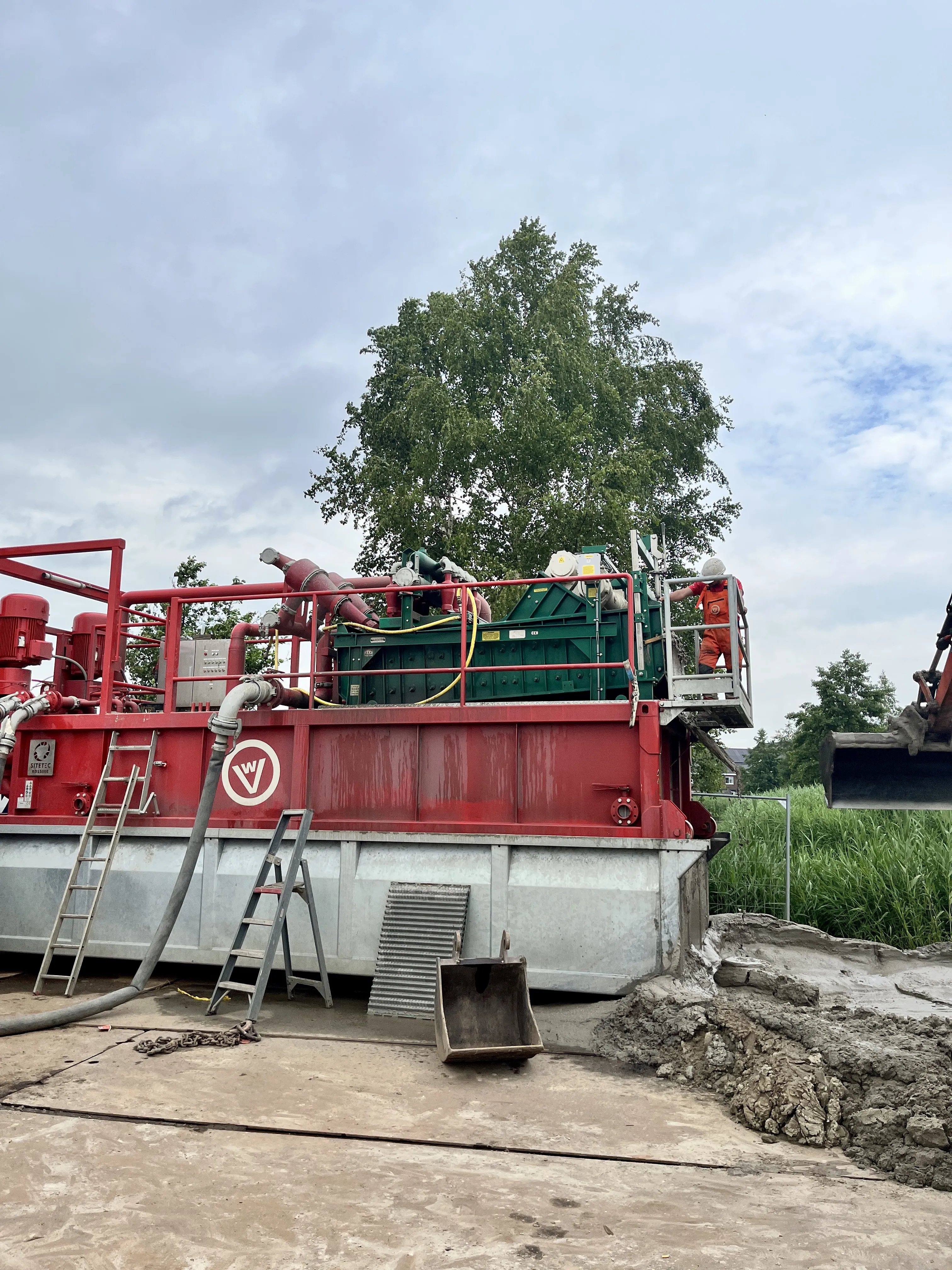
“When we presented the plan, they were taken aback by that, especially with a nursery and schools nearby. Because we already had experience with the Tonghand, we could respond quickly. We proposed forward reaming to drastically reduce the amount of drilling fluid that needed to be taken away. Up to the final 80 metres, we don’t need any vacuum trucks at all,” Piet explains. “We have less than 35 cubic metres of container capacity on site. It hardly gets more compact than that. The municipality is happy, and it pays off too, especially with three bores on this site alone.”
From rental test to investment
“At Welvreugd we think it’s important to try new methods we believe in,” says Piet. “SiteTec is a very good partner for that. Because they supply more than just the Tonghand, we can look at how the tool fits into the complete setup, from mixing and pumping to recycling and pipe handling. Now we just need to make sure the recycling can keep up with Michel at the exit side,” Piet says.
Having experienced the benefits first-hand with the rental unit, Welvreugd decided to buy a Tonghand of its own. The tool has now been ordered and will be delivered after the summer, while operator Michel has already received his certificate following training by LaValley Industries.
For Welvreugd, the Tonghand is an investment in a way of working. One that, on the right projects, saves time and money, reduces transport movements, improves operator safety and helps the client fit the work more smoothly into its surroundings. Thanks for having us Welvreugd!